
The Enzmann Archive
Dr. Robert & Joanna Enzmann
Click for Posts
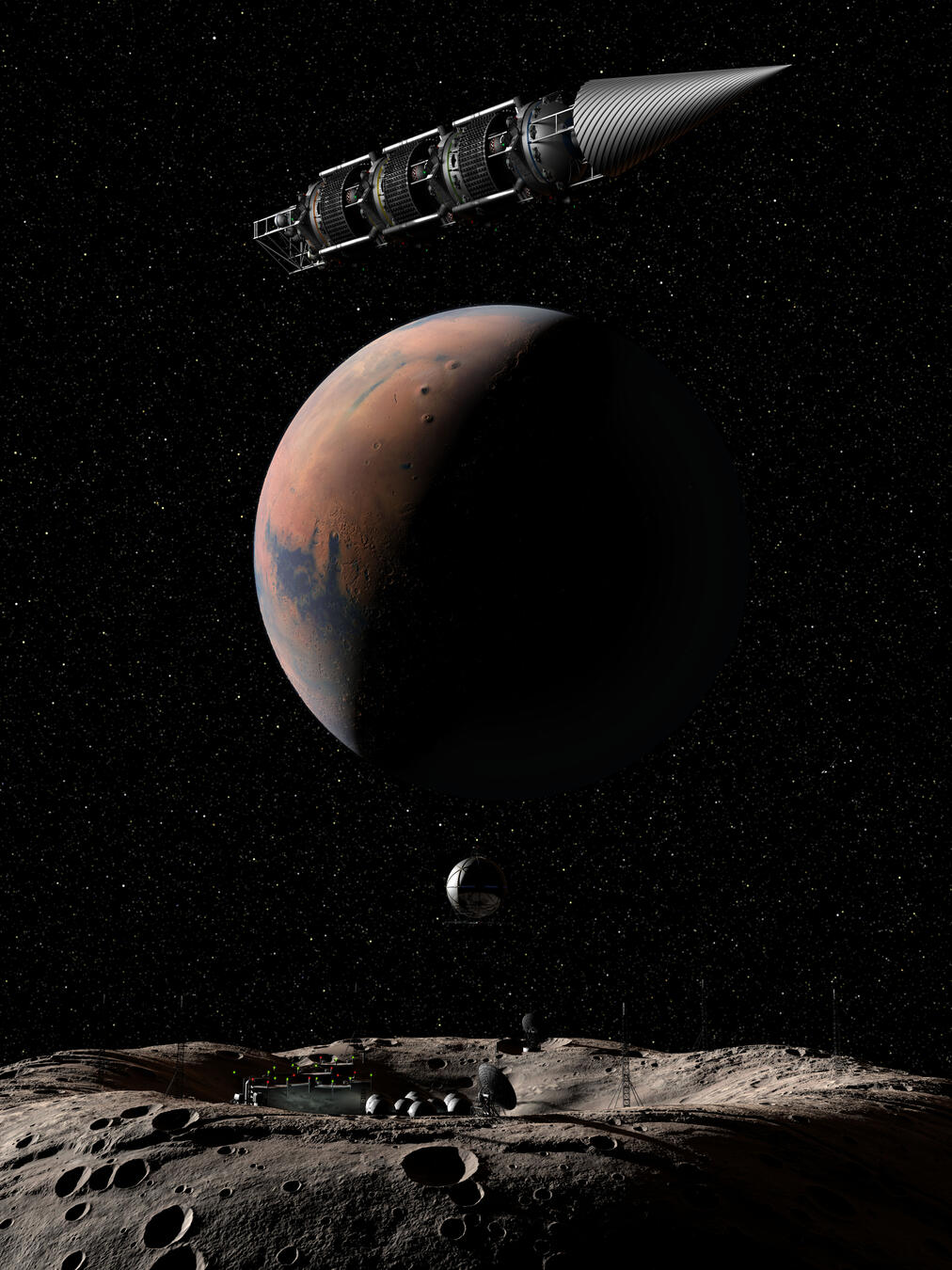
We should have gone
The Grand Design
Dr. Robert Duncan-Enzmann designed a network of transportation systems for humans occupying space. His space mission plans are not new ideas, nor are they science fiction.
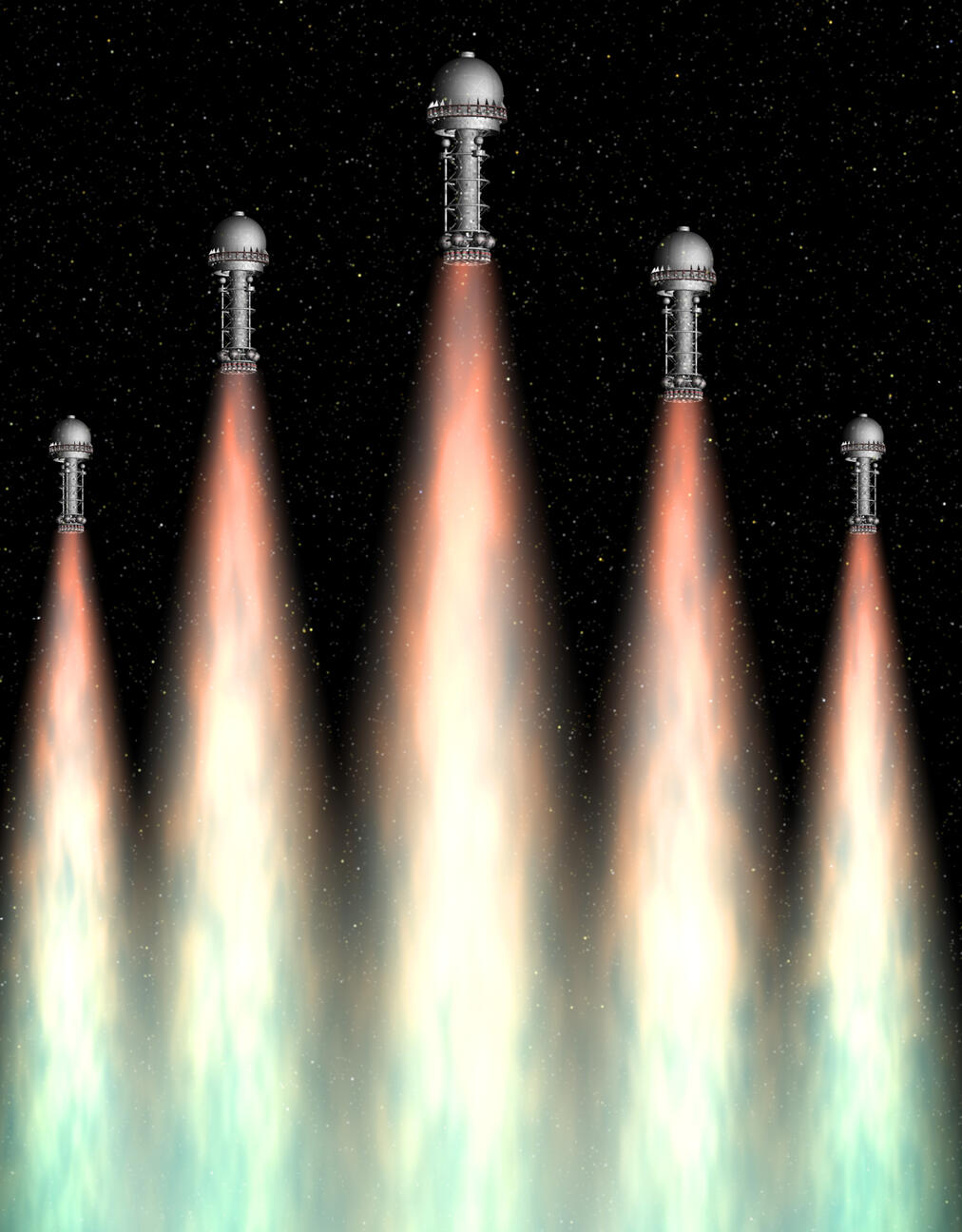
The Enzmann Starships
Let's go now
"Enzmann’s ships may not be the last word, either. But they are parsecs beyond anything that now exists outside the pages of a science-fiction magazine, and every sign indicates that we can start building it now." - Frederick Pohl, 1963
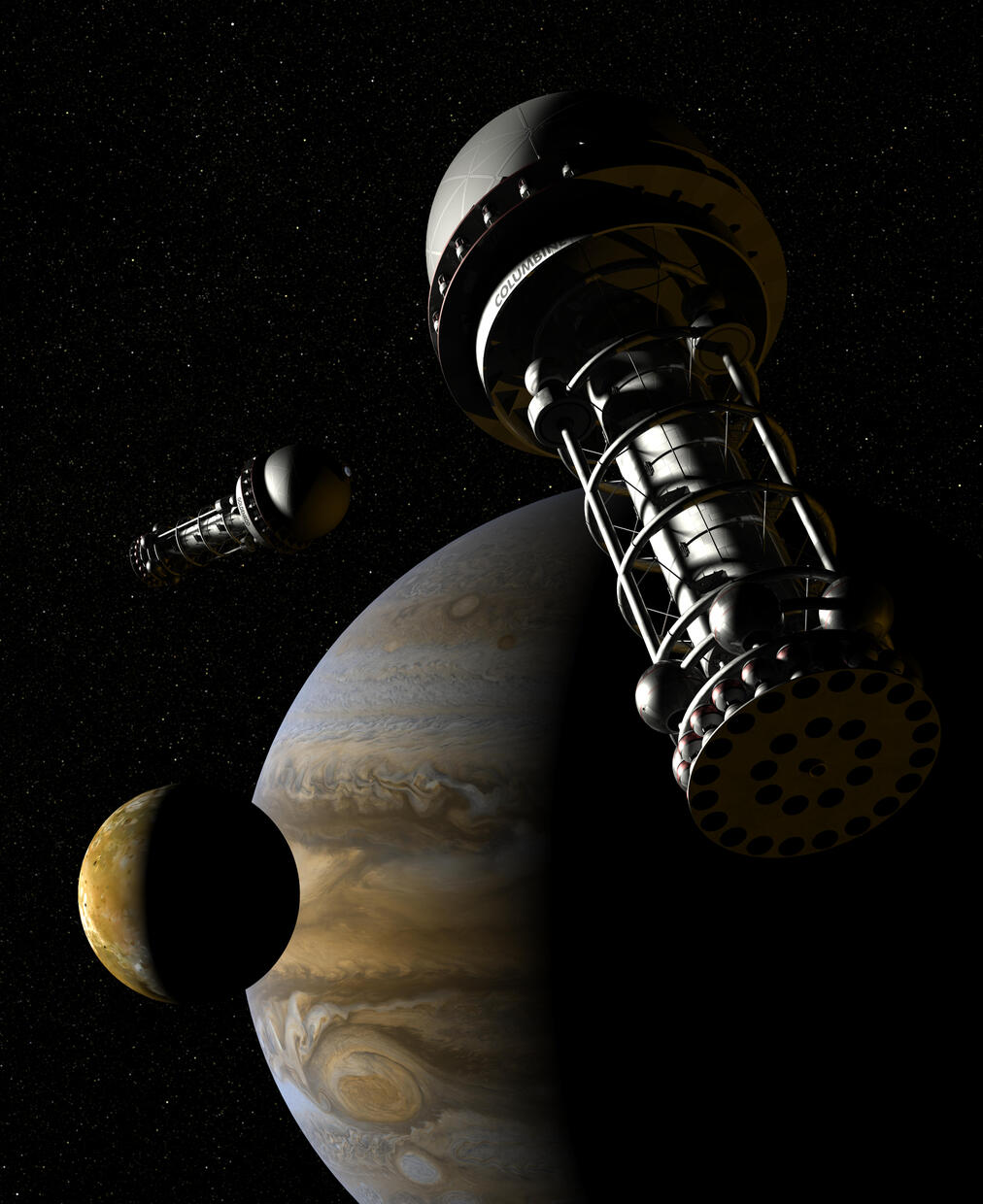
"Let's set sail for the stars; it's pointless to wait." - RDE
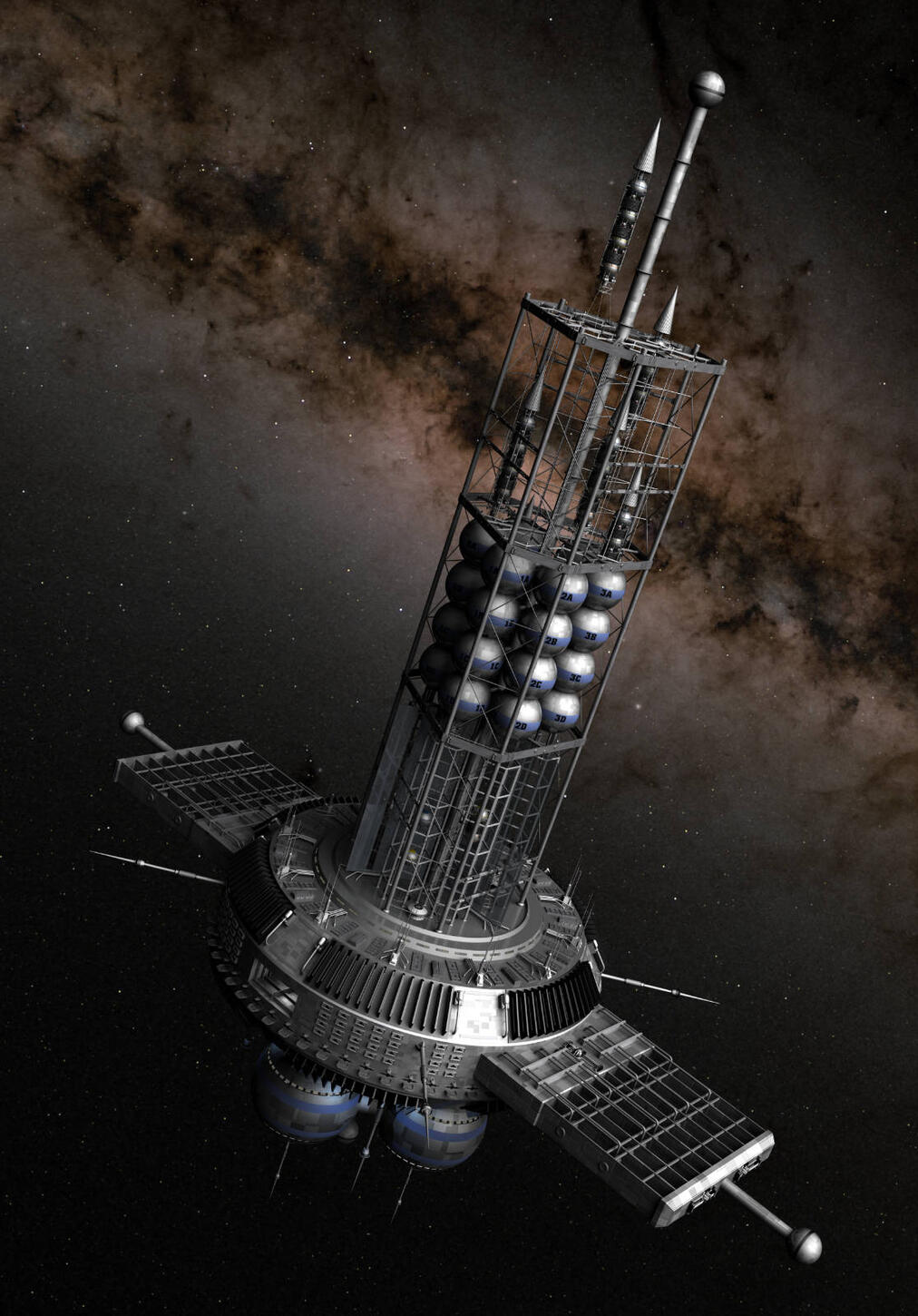
the enzmann echolance
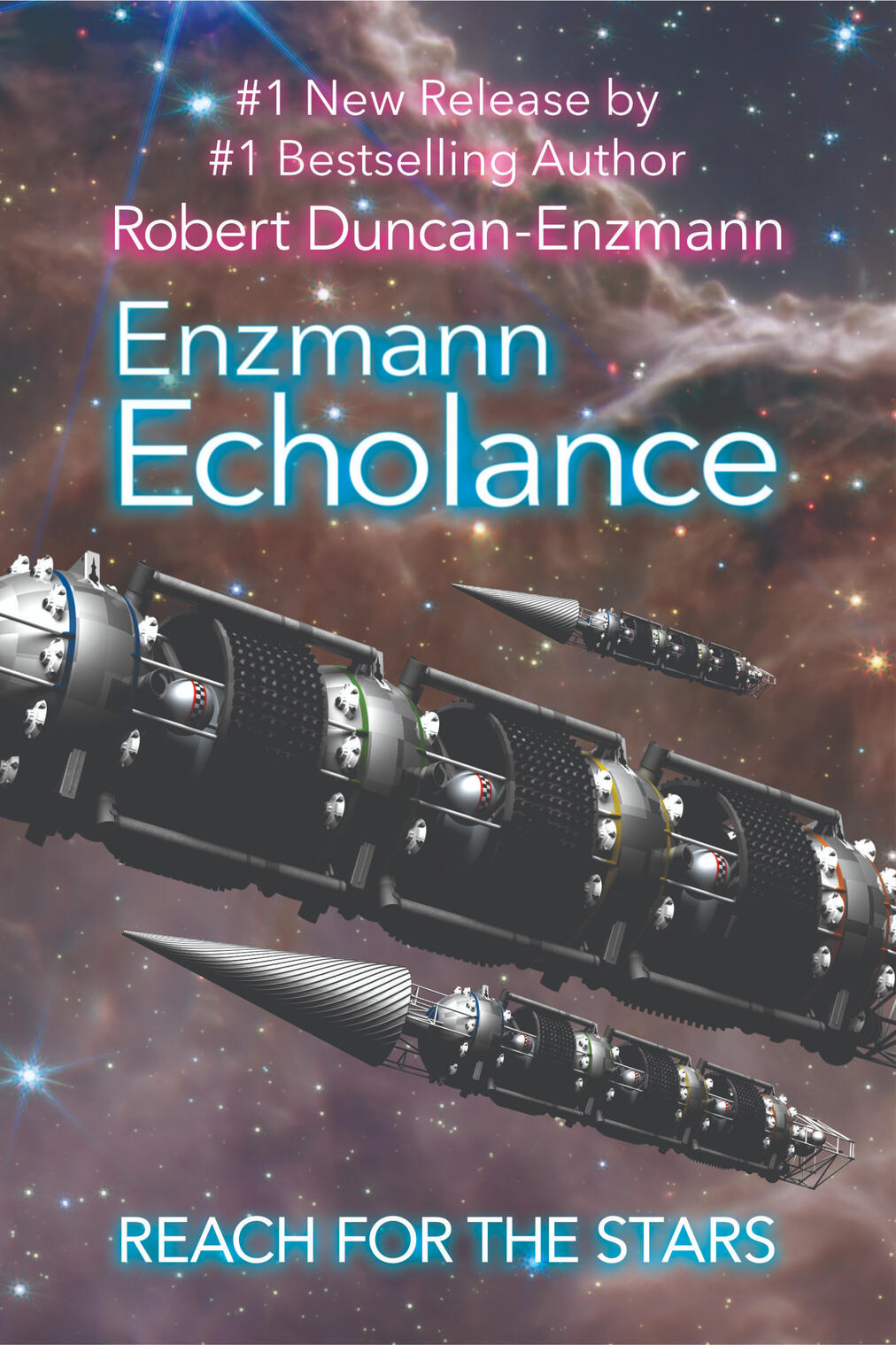
"I have studied physics at the local university, and astronomy at the University of Stockholm in Sweden. As a fan of Science I decided to do some calculations to determine if the claims of the book are within our technological capabilities today, and the answer I have reached is yes!" - Soren Jonsson
the enzmann shipyard
building starships
Located near the Moon and nearly three miles long, the Enzmann Orbital Shipyard has the size and capacity to mass produce three different kinds of Enzmann starships: The Enzmann Nuclear Pulse class passenger starships, the Enzmann Torch class cargo starships, and his newest release – the Enzmann Echolance deep-space starship.His orbital shipyard design is built from a main axial support with elevators throughout for observation, command, and communications hubs at either end. It runs lengthwise in the center of the orbital shipyard. It designates up and down with its heavy end always pointing toward Earth. The lower end of the vertical axial support is for traffic control, and command center for communications with Earth.
A SHOVEL FULL OF SAND
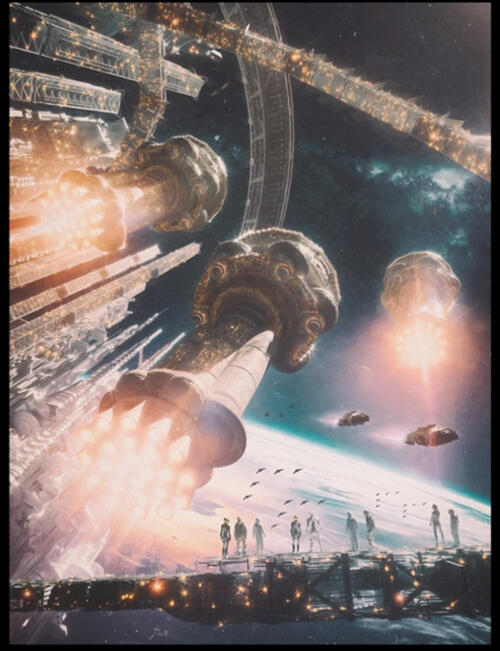
While investigating the endless material in the Enzmann Archive is truly an enlightening experience, conversations with Dr. Enzmann continue to produce new material. For example, A Shovel Full of Sand. Brief, but interesting. Here is what I wrote down while he taught me.Off-center grinders produce perfect spheres. This has been known for millennia. Use them to create perfect spheres of quartz sand. Perfect spheres of quartz sand can produce immense energy. But how to release it?“That’s easy,” he says. It is his favorite expression. Most things for him are easy. Here is how:Enzmann Mirror focuses a laser to explode the sand spheres creating fusion. A regular mirror will not do. Lasers shatter mirrors. Enzmann Mirror is an invention by Dr. Enzmann. One mirror expands the laser beam while a second mirror focuses it to fusion temperatures. When focused on a perfect sphere of quartz sand, an unbelievable amount of energy is released.A shovel full of sand can power a starship for centuries.So here, in a ten-minute conversation, Dr. Enzmann has yet another solution to propulsion in space, an alternative to the very limiting chemical propulsion so popular today. Chemical rockets will never reach deep space. Well, unless you are one of those who seem to think the Moon is in deep space. It is not.
ORDERS OF MAGNITUDE

The writer believes that all actions and reactions, all aggregations of matter, all shapes – in effect all entities and their interrelationships – are ultimately controlled by, and may sometimes be described by what we currently call quantum mechanics.Current mathematical techniques only permit mankind to describe two-body relationships as in the hydrogen atom, ionized helium, or satellite about a planet unperturbed by other bodies. Current mathematical techniques make it possible to approximate solutions to simpler multiple-body problems. Mathematical techniques, which are in essence statistical, make it possible to describe, in a limited way, the formation, metamorphoses, and dissolution (history) of such features as plasma, gaseous, and fluid vortices. Mathematics does not pretend to describe by abstractions the history of all entities of a planetary domain, stellar system, or galaxy. Approximate mathematical descriptions (abstractions) may be possible sometime in the future.Currently, such entities as planetary domains are described with a mixture of pure taxonomy (description) and taxonomy with some measure of mathematical abstraction. In this section, a systematic approach to planetology is ventured. This incorporates available taxonomy and abstraction in a scheme that is orderly, rigorous, and sufficiently broad to provide ‘slots’ for entities that are as yet undescribed.The first step in the technique has been to divide the matter in the planetary (or any other entities) into states of matter. It is then possible to assign the bulk of matter in such states the name of planetary zones. The states of matter and the respective zones are as follows:Corpuscular or plasmoid: Electrospheres or electrofluxesGaseous: atmospheresLiquid: hydrospheresSolid: lithospheresBiotic: biospheresStressed solids: EndospheresThe second step in the technique has been to divide the zones of terrestrial-type planets, gas-giant-type planets, comets, asteroids, and smaller entities of the Solar, or other (as yet slightly known) stellar systems, into orders. Planetary domains have been divided into eleven somewhat arbitrary orders of magnitude. It is recognized that there are orders of entities significantly larger than planets etc., so the classification has somewhat arbitrarily been extended to incorporate larger structures up to super-galaxies. These are the largest orderly structures currently known to mankind; they seem to incorporate many millions of spiral nebulae like the Milky Way. The writer does not feel that the extension upward will be as useful as the classification of entities in planetary domains, but it is an interesting speculation. The orders are listed below.All entities within the universe can be classified into morphological orders. These orders are based on size. Coincidentally the organization of matter into entities in orders based on size is often, in addition, a classification based on forces acting to form, metamorphose, and disperse the entities. The steps in the order classification are often also steps in sequences through which matter evolves through classes of entities.Orders:
-10 Super Galaxies-9 Super-galactic structure-8 Clusters and groups of galaxies-7 Galaxies and CIS-galactic satellites-6 Individual galaxies-5 Galactic structure-4 Clusters and groups of stars (globular, open, streams)-3 Individual stars-2 Planetary systems-1 Individual planets, comets, asteroids0 Zones of planets and stars1 Hemispheric or circumplanetary features2 Continents and oceanic domains3 Geomorphic provinces4 Individual mountains5 Mass waste sequence6 Sediments8 Secondary molecular structure (as alpha helices)9 Molecules (relatively simple)10 Elements11 CorpusclesDr. Enzmann’s Expanded Order Theory is published in the Encyclopedia of Geomorphology, published by Rhodes Fairbridge.
Light and Lenses
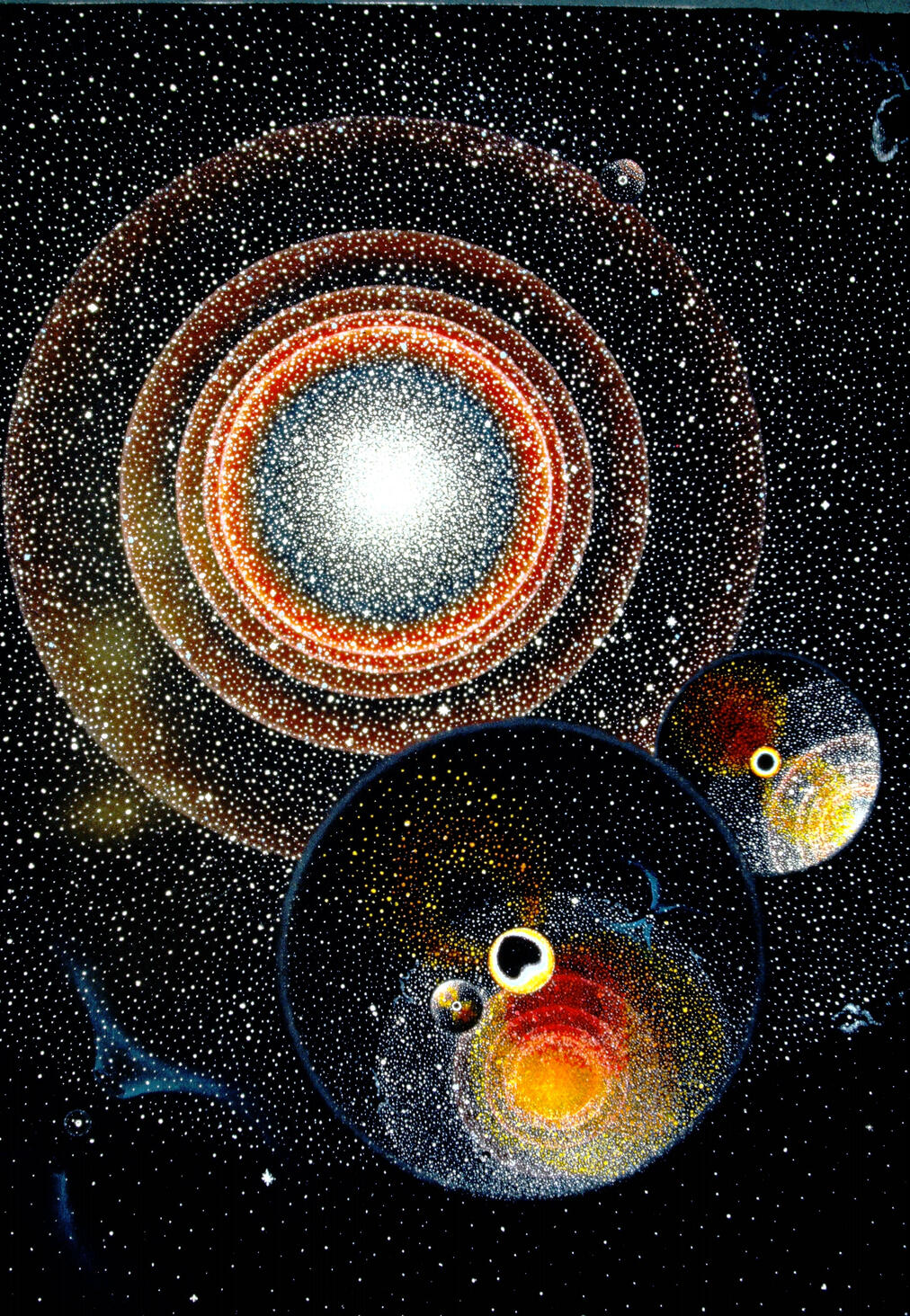
Image: Painting – Gravitational Lensing by Don Davis and EnzmannThe editor found these notes in a spiral-bound book of papers. Light is a wondrous, magical thing. Light is associated with warmth, intelligence, enlightenment, and life itself. Light reflects, refracts, and emits in rays. Our eyes receive light, lenses manipulate light, and photography is the art of capturing light. Written about 1950sDiffractionLenses making use of diffraction are among the oldest in the world. The Pin Hole camera is the best-known example. Less well known are Bee-Bee cameras, in which the light is diffracted about a tiny sphere supported by filaments.Diffraction can increase the effective size of a mirror. How astonishing to see around a corner just using your finger. It works. It is startling – to increase the width or height of a mirror, to see around a corner by holding your finger in your field of view and moving it toward the edge of a mirror.The effective sizes of both flat mirrors and curved telescope mirrors can be extended by refraction. Similarly, such plants as evergreens extend their effective sizes by diffraction, and mariners find some measure of safety and relief from storms by mooring – or standing at rest – on the flanks of a peninsula.Why should this be? How can this be?The leaves are subhedral, angular, they have V-shaped clefts. How then is the light patterned into circles?The light on forest floors is diffracted. The spaces between leaves act as does a pinhole camera. The round and sub-rounded patterns of light are images of the sun.Temperate forests have but one canopy. The might tropical forests are not just treasure houses of strange plants and animals, but also physical laboratories in which the properties of light are wonderfully developed. Tropical forests usually have three, sometimes four, and occasionally – int those rare places untouched by mankind – five canopies.One canopy can only be as thick as shadowing permits. A second canopy can only form at a distance far enough down from the first such that light has formed a diffraction pattern of circles. This is why there is an empty space between canopies. The pattern can repeat several times.ReflectionSaid the professors at the Platonic University to the Mighty Men who spiritually guided the church: “If the Moon were perfect, we would see it only as a brilliant spot in the heavens.” He continued, “Why does the Sun form rays in the atmosphere when it is amidst the clouds?”The ‘Fathers’ of the church were furious. The heavens were perfect. Mankind should be directed toward credibility. The heavens were perfect. Knowledge was evil.Swiftly was the matter resolved, the ‘Christians’ burned-out libraries at Athens, Corinth, Rome, Alexandria, Marseilles, and all other national, state, city, and private libraries they could lay their hands on. Schooling was stopped, reading in itself became a crime for almost a thousand years.Universities were destroyed, professors executed with a few fortunate exceptions who were imprisoned or allowed to spend their lives at hard labor. The Greek educational system of elementary, grammar, and high school, and post national service was abolished – not to appear again until the 1800s.The Church ‘Fathers’ had their way. The Heavens were perfect. The Moon was a flawless sphere. So perfect were the Heavens that there is not a single report of Haley’s Comet in Medieval literature. After all, it could not exist in the Heavens, for they were perfect and unchangeable.Note: A curious exception is a needlework we call the Haley’s Comet Tapestry. But after all, this was a vision of females – the weaker, inferior sex – what girl could understand the perfection of the heavens.Wonderful indeed is the raying sunlight amidst the clouds. How can this happen? It is related to the nature of perfect spheres which the long-dead and long-hated Platonic Philosophers discussed.How curious that no matter where we stand on the landscape the rays in the atmosphere seem to point right toward the Sun. It is not a small matter to explain this.Here are some clues:When driving at night the windshields of cars with tiny droplets upon them will develop rays that point right toward the eye of the driver, or passenger.The next clue is the sky itself. If raying is looked at very carefully it will be seen that there are both easily seen light rays and also less-apparent dark rays amidst the clouds. Regardless of where the observer stands, both the brilliant light rays and the faint dark rays will point directly toward the Sun.A last and most important clue is found in the beautiful silvered spheres that gardeners love to place near sundials, pools, and little glades and gardens in their works of art. How brilliantly the spheres reflect the Sun. Like windshields in a parking lot on a clear day, the silvered spheres reflect a tiny image of the Sun toward the viewer. You can scarcely escape it. This is what Plato said the Moon would look like if it were indeed perfect. Plato claimed that the Moon must have a rough surface.Lenses in NatureThere are lenses in nature. Is it possible that there are natural photographs, somehow left behind from natural lenses for mankind to discover?Lenses are not simply inventions of the wonderful world of animals. Lenses are used by plants. They are, in the slowly evolving world of plants, a rather recent development.Plants of earlier times used simpler techniques of absorption. Early on they formed structures that could enhance absorption with diffractional effects.Evolution continued with the development of what seems to be a combination of Light Pipes – developing naturally hundreds of millions of years before mankind happened upon fiber optics – and bionic Lenses, known to the Greeks and patented by R. D. Enzmann. Natural ‘fiber optic fibers’ are found on Polar Bears; whose fur is not fur but clear tubing. It is likely this coat of fiber optics channels the sun to the skin of the animal.Lenses are common, almost all leaves of deciduous trees develop them. Could there be photographs?Distorted lenses are abundant among the tiny silica-rich structures called phytoliths, which are found in almost countless quantities in the soils of the world. They are very tiny, often just barely visible to the eye, even tiny when viewed with a hand lens. One might ask: Can such a small thing act as a lens? Can that be, can a microscopic structure manipulate light?It can. Indeed, it can. Consider the eye spot of a Paramecium. Fibrils are connected to it. Careful observations suggest that up to 500,000 contacts are made between fibrils and eyespots. It is possible that the critters not only respond to light with heliotropic reflexes, but also form images!It is possible. 500,000 contacts suggest that the daring observers who jokingly say ‘I’m looking down through a microscope, and sometimes it seems as though one of those things looks back up at me as though the microscope were a telescope from where it is!’ might be right.The lenses are there. Are photographs lying there as well? Waiting to be discovered? What a stunning discovery if there are natural photographs from millennia ago. Think of looking back at the walls of Troy or viewing our ancestors of 28,000 years ago who hunted mammoths, carved figurines, even molded and kiln-fired ceramics. Think of the pictures that could be recovered.It is asking a great deal to search for such a view; but could the field of Photo Archaeology be established as a science by demonstrating in principle that such photos exist, and finding a few such images? They could even be quite crude, but if only the supposition can be demonstrated as valid – if only that – then armies of workers will march along the suggested trail.And then, such wonderful images such as Rhodes in the days of Alexander might be brought back for all to see.
A Humorous Trek Through History
Sauerkraut & Bullfrogs Boiled in Vinegar
Robert Duncan-EnzmannIn 2011 construction workers in Colorado (USA) dug down into a one-time pond now filled with sediments. At a level dated to about 45,000 years ago, bones of numerous mammoths were found. Curiously the bones were more-or-less in separate bundles. Many bones had cut and scrape marks as though the meat had been in part cut away. Even more curious were hefty rocks associated with each bundle of bones. The date is outrageous. Conventional archaeology knows no humans were in the Americas until about 12,000 BC.Note: The Colorado discovery would be an excellent addition to Forbidden Archaeology, a book largely regarded by conventional archaeologists as writings by erudite charlatans. It is excellent and has impeccable research reports. I venture marinated mastodon is what was discovered in Colorado. But imagine! People in the Americas ca 43,000 BC!! (See Forbidden Archaeology. 1993. Michael Cremo & Richard Thompson. Bhakti Vedanta: Los Angeles.)Ca. 9450-9370 BC, Allerød-II, to cold, dry Inter-Allerød II/III little ice age cultures include the Creswellian, England, Azilian, France & Iberia, Tjongerian, Scandinavian, Romellian, Italian.Ca. 9500-9450 BC Stellmoor (vinegar) Site, Germany, Stellmoor hunters used: tanged-flint Zonhoven arrowheads, harpoons, scrapers, burins, needles, weaver’s battens &, calendrics (usually engraved on reindeer ribs) often with engravings describing spinning and weaving.Marination Woodland Deer construct of the Stellmoor observations.
In one peat bog, a wooden post had a reindeer’s skull on top. I have always contended this indeed marked the location of between 600 to 700 reindeer sunk in a pond and that this had nothing whatsoever to do with sacrifice. The skull on a pole marked the location of a meat locker. I found that more than a few reindeer were associated with stones.See: Mesolithic Settlement of Northern Europe.1936. J. Clark. Cambridge Univ.See: Vor 20,000 Jahren. 1962. A. Rust. Karl Wachholtz Neümunster: GermanyIn Siberia of the 1930s, we shared a delightful treat – ‘twas said to be 20,000-year-old mammoth meat. We got ours before the dogs had a chance to eat all of it. It tasted like vinegar, which kills germs. I note that the Siberians also prepare sourdough, which is more vinegar-like than alcoholic. A naturally marinated baby Mammoth that fell through a pingo is what we ate after the guides chased away our dogs.Note: These were the years when we lived in Peking and periodically traveled via Trans-Siberian Diplomatic Wagon Listed trains to and from England and Central Europe. Thank God, my mother, Florence-Rebecca Goodman, whose twin sister was named Rebecca-Florence, did insist that we “Get out of this place” (madhouse Europe) and live in Bath, Maine from whence she came.British ‘Limies’ German ‘Krauts’
That lime juice prevents scurvy is nearly universally known. That German science took another, and just as effective path is scarcely mentioned. It’s told by reliable sources that large German diesel-electric cargo submarines equipped with saddle tanks having cruising ranges of +35,000 miles, steeped sauerkraut in the engine room. Our best data from such subs are verbal allegations concerning the so-called Fifth Submarine. There were five. One sunk in the North Sea, one sunk on the Atlantic Equator where Ballard dived to recover its cargo of gold, one surrendered at Portsmouth with a ton of bomb-quality uranium, and one went somewhere Number five, “The Fifth Submarine,” super-stretched, commandeered by Brandenbergers, a WWII German Foreign Legion fed-up-with Nazis that escaped in 1945 with over 300 men, women & children on board.Stewing sauerkraut in their engine room goes to show that vinegar marination, which is one bacteriological step past beer brewing, may have preceded beer brewing by millennia.(See: Critical Mass. 2004. Carter Plympton Hydrick. Whitehurst: Flemington, NJ)Note: We know of no written material concerning Dr. Schonland, an Afrikaaner [Boer] and world-class physicist, who probably masterminded the design of England’s atom bomb and at the same time directed S. Africa’s uranium yellow-cake to the U.S.A and England. I met him in an unusual way. Interested in age determination with mass spectrographs, I got acquainted with physicists at the Witwatersrand University in Johannesburg. I sat reading Die Burger, and Oss Wah Brandwach Publications, feet on the table. Someone behind me said: “Will nie rook?” (Care for a cigarette?)“Nier Danke ek nie rook nie!” (No thanks, I don’t smoke)In Afrikaans: “Americans can’t speak Afrikaans!!!”
In Afrikaans: “Well, a few of the important things like: Asseblief var ist die Kaffe Kammer Bioskope – Please, where’s the Tea Room Bioscope?”We were soon on very friendly terms. We shared, among many things, a keen interest in S. W. Africa’s 1916 Strong Children’s trek to Tanganyika, where, zig-zagging thousands of miles, sniping all the way, they joined von Lettow Vorbeck. They fought with him till 1918 when they surrendered honorably.They were curiously tough, steeped in ethics and traditions of the “Brandwach” – wagon train sentinels who compare with America’s Oregon trail pioneers. My favorite trek-train was one with 60 men and grown-up boys, over 200 women, and well over 700 children, most of whom survived. They trudged most of the way barefoot. Mother had relatives in that group.Pickles, Acorns, and Olives
That pickles may have descended from sauerkraut steeping, which was invented by an unknown and therefore, an un-honored genius, is easily imagined.Yet another giant culinary step forward is acorn-steeping to make acorn bread which we suggest was practiced at least by 31,000 BC Aurignacian Rhone-Rhine-Danube peoples.Olive steeping is later, perhaps 10,500 BC, in uncomfortably cold Dryas II and Allerød centuries, impelling northerners southward where olive trees grow.
Introduction to the Section on Environments
Dr. Robert Duncan-Enzmann
Annals of the New York Academy of Sciences, vol. 140, ART. 1.
Planetology and Space Mission Planning, 1966“What is space?” “What are we going to look at in space? Are there any regularities or patterns associated with the things of space? The content and arrangement of the papers in this section hive a generalized answer to these questions. It may seem surprising, but most of the papers are devoted to geospheres of the Earth. This has been done deliberately to indicate that the first object in space studied by mankind was the Earth. The Earth was first of all studied from its surface; and more recently from space, therewith creating new and useful geophysical systems.The regal importance of the Sun as the massive and energetic center of the Solar System is acknowledged by the paper entitled The Evolution of the Sun. The corona of the Sun consists of Electrofluxes of primary particles and ionized elements; it probably extends beyond Pluto. The satellites of the Sun form four regular groups: Terrestrial-Type planets such as Mercury, Venus, Earth and its Moon, And Mars. Asteroids mainly concentrated bands between the orbits of Mars and Jupiter; Jupiter-Type Gas Giant planets including Jupiter, Saturn, Uranus, Neptune and probably Pluto, and Comets known to be concentrated near Jupiter’s orbit (Jupiter’s family), and also know n as very long-period bodies that recede great distances from the Sun.The zoned substance of the Sun, the planets, asteroids, and comets are molded by the action of fields (mostly gravitational) and balances of exogenetic, endogenetic, and stored energies. Action of these fields, internal, external, and stored energies upon the geospheres of these bodies is considered in the papers: Energy, Time, and Morphology, and Endospheres and Inter-zonal Coupling. All of these bodies can be divided into one or more zones plasmas, gas, liquid, solid, or stress-fluid.* A planetary sphere composed of matter in one state is called a geosphere. The best explored, described, and mathematically-modeled geospheres are those of the Earth. These can serve as parametric models for all similar geospheres of other bodies; so the bulk of the Environments Session of the Conference was devoted to geospheres of a highly accessible and interesting planet of the Solar System, Mother Earth.*A stress fluid is a somewhat unscientific but useful term which indicates the highly compressed matter of planetrary interiors below the Mohorovicic Surface as being other than solid.
What Goes Up Must Come Down
Dr. Enzmann & Michelle Snyder
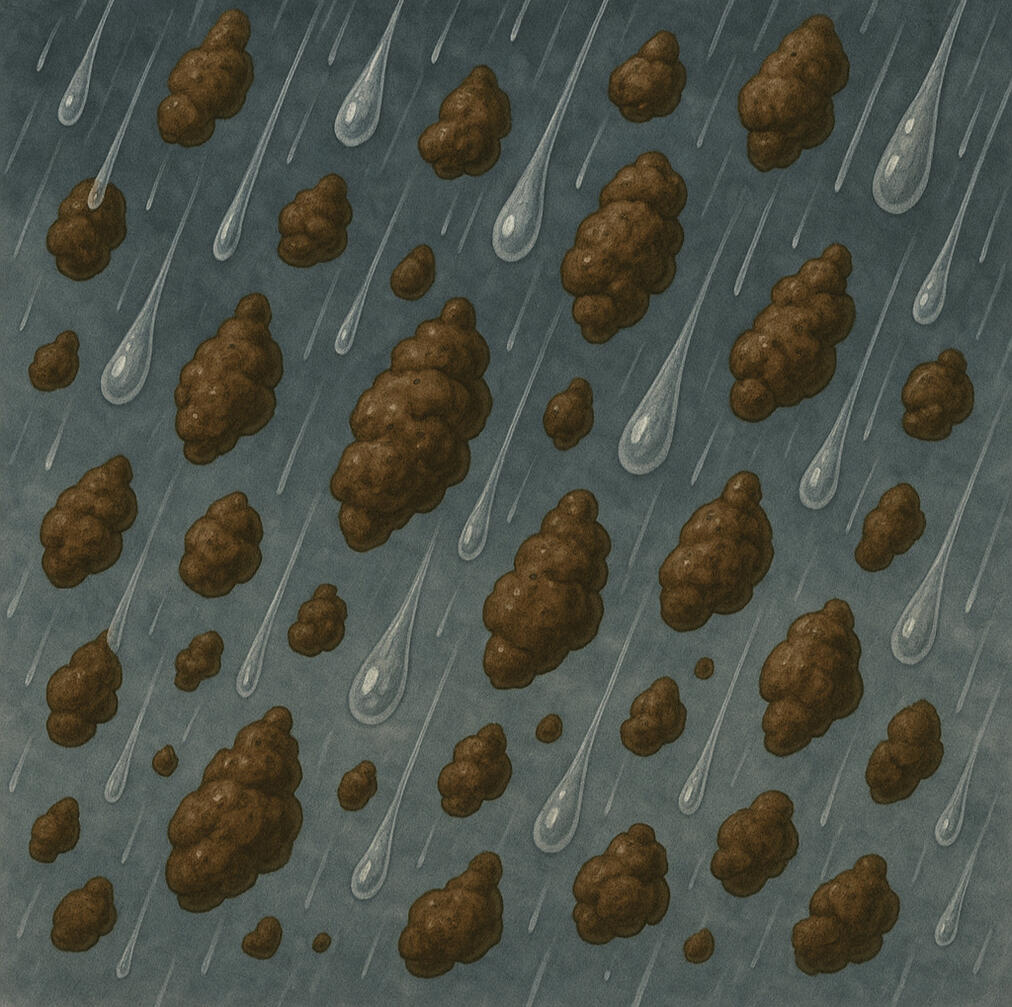
Yogi Berra said, “It’s tough to make predictions, especially about the future.” But here I venture an inevitability for readers – a prediction of sorts.America boasts the world’s largest pig farms, some with 30 – 100,00 swine, each with a giant cesspool. Each cesspool can receive up to 10 pounds of excrement per swine, per day. Pigs’ poop has no commercial value. It can’t be recycled into something useful – nuclear waste at least has the possibility.‘Businessmen’ offering small towns jobs and prosperity with these enormous swine farms have barely escaped deplorable vigilantes planning to tar and feather them. A ‘study’ reveals many big pig farms are in America’s meteorological Tornado Channel.Pig farming could benefit enormously by using the Mississippi River as a continental sewer, but opposition is extensive. Sooner or later a tornado will pass over a pig-poop pool, empty it, drain its contents aloft, and carry it away.
What goes up must come down – imagine the emotions over the fallout pattern!Almost everything I write concerns rocket science and we avoid building launch pads in Tornado Channel... which got me thinking about the aforesaid farms. Now let’s consider a similar subject in space.Scatology in Space
After a prolonged interstellar voyage, the temptation to increase velocity and interior free space by ejecting unnecessary mass, es-specially tons of accumulated feces, is great.Spectacular! A gigantic release that precipitates the cosmic crap, the sight of which could make elephants feel like amoebas. A technological advance that would have delighted Thomas Crapper, the renowned English inventor of the commode: The use of interstellar space as a toilet.There are perils of dumping feces at relativistic speeds. What if intelligent extraterrestrials encountered our flying feces? They might retaliate for being bombarded by a contaminated biological weapon traveling at near-light speed. Or, they might dismiss humans as being undeserving of pursuit, as being members of a species that must be "full of it."The greater danger is that human voyagers will foul their own cosmic nest. When they decelerated as they approached an idyllic landfall, their past might catch up to them. As they dispatched exploratory fanjets the shit might hit the fan at over 185,000 miles per second!There would be a need for powerful shields to protect from catastrophic collisions with incredibly hot mass of it while in the refrigerator of inter-stellar space.Better yet, voyagers aboard star-ships traveling at relativistic speeds need to follow the First Ecological Commandment of Space: Thou shalt not dump at relativistic speeds."The Morality of Space: Don't do to others what you would not like them to do to you.
Fires of Phosphoria
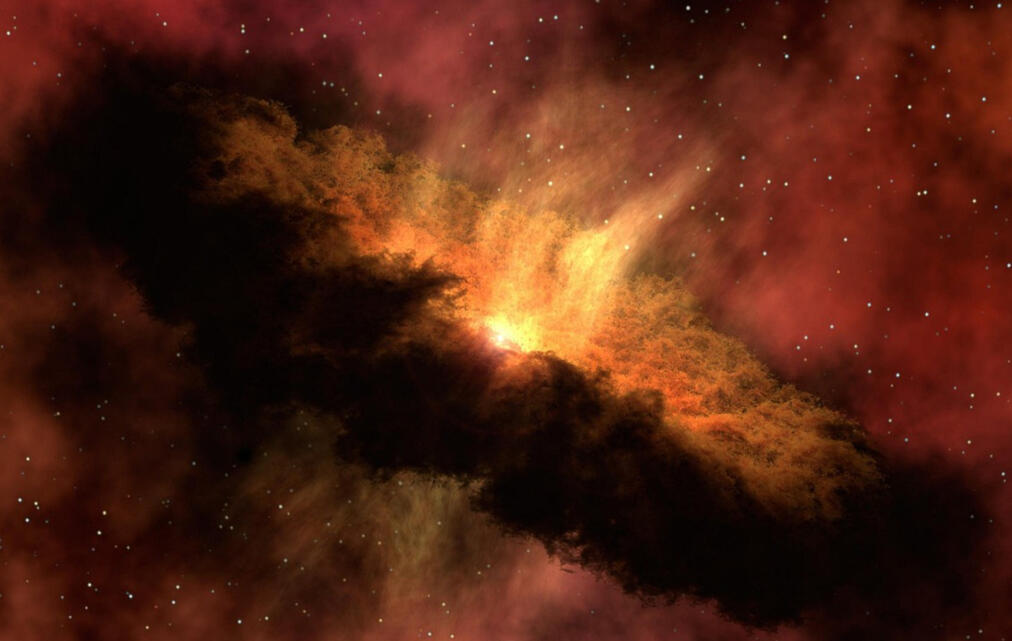
Like the day of President Kennedy's assassination, there are moments most everyone remembers. I was sitting in a GCA unit (Ground Control Approach) when our radio men interrrupted all communications to tell us what had happened at Hiroshima. Each of us had different thoughts. I only remember my own, which were "This is it. A dream of centuries, realized, now becomes an engineering problem." With this bomb, now mankind will build ships that voyage to the stars. God rest the pitiful victims, our people, the wretched who perished in fire raids on Japan. And may God continue to bless we who survived, and also our then millions of surviving opponents who would have stood bravely, suiciding everything that could fly, on the beaches and inland all in their services, then reserves down to groups with a few firearms and bamboo spears.There were times that not just I, but others, could not help but cry. How brave and wonderful people are, all people, but mankind profiting from competition should never fight man against man. The glory of battle is against nature, not others of ourselves.
What We Might Find!
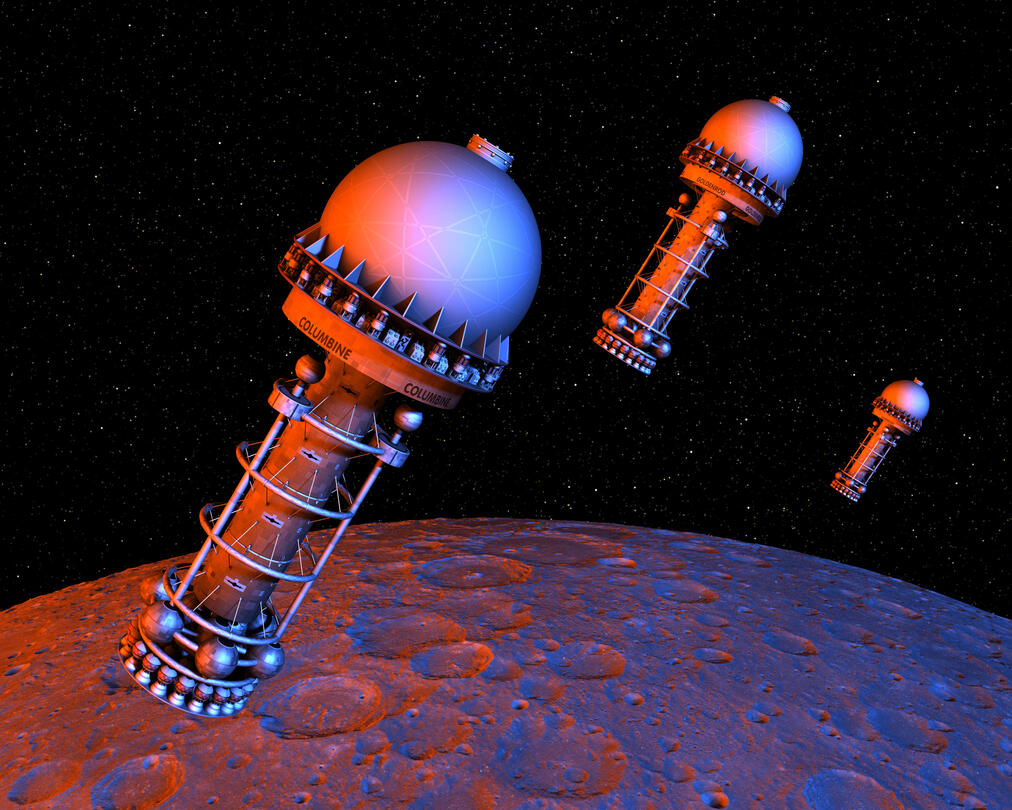
We should go now! This has been procrastinated - no, let me be honest - canceled long enough. Just the science that could be learned is astounding.Gas giant & ice giant planets have moons that may be glaciated. I venture that we will discover methane, water, carbon dioxide etc. glaciations on moons of the gas giant and frost giant planets Jupiter, Saturn, Uranus, and Neptune.The Kuiper Belt and Oort Cloud Cryo-sedimentation is bound to be there and in these layers we’ll find a history of the Sun’s genesis, its wanderings in the Milky Way, along with evidences of neighbors and neighboring events over time spans of five to perhaps ten billion years.The present generation must be smarter about this than the ones who lived 50 years ago. Just do it!
Santa and the Spirit of Giving
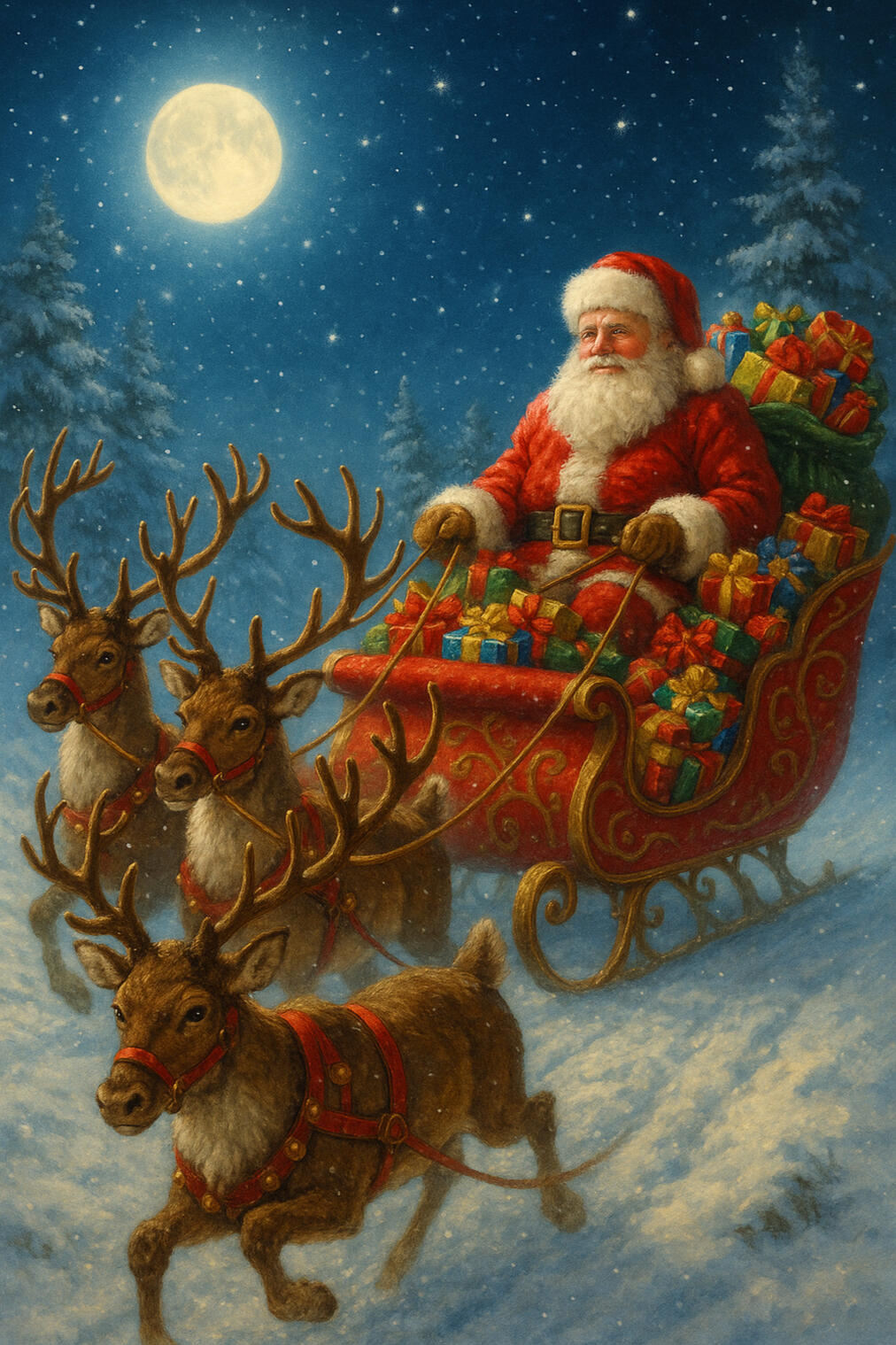
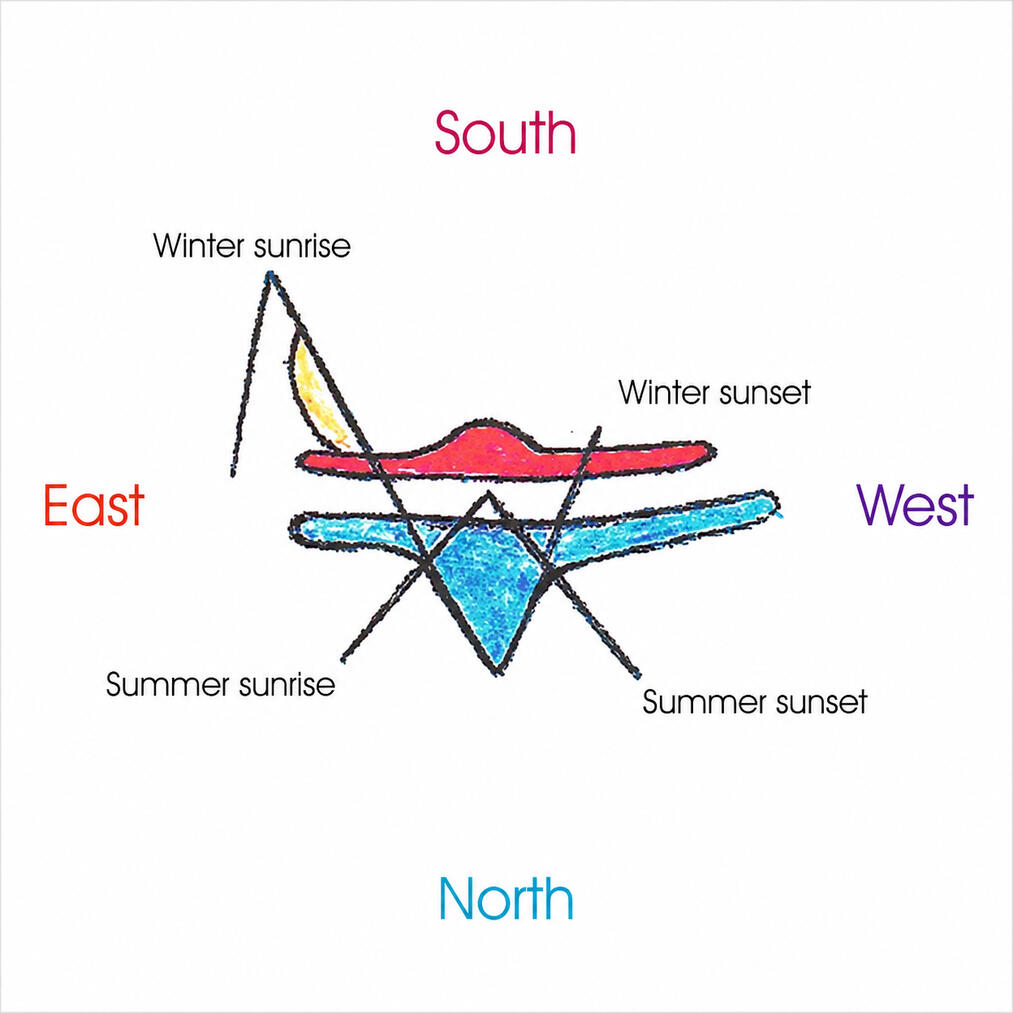
Many cultures celebrate the birth of a wondrous child, a figure representing hope, renewal, or divine presence. For Christians, Christmas honors the birth of Jesus, as described in the Gospels. Yet long before those stories were written, ancient peoples across the world marked the rebirth of the sun at the winter solstice. Whether called Shamash, Ra, Horus, Mithras, Krishna, or Surya, radiant deities symbolized the eternal source of life. Even in prehistory the sun was personified, sometimes as a maiden or mother figure who brought life into the world. These symbols endured for thousands of years as humanity reflected on the returning light.To Ice Age families, the arrival of a child was a celebration of survival. Evidence suggests that as early as 12,500 BC, people encouraged conceptions in spring so babies would be born in deep winter, when families stayed indoors and could provide constant care. Harsh as the climate was, winter births offered the highest chance of survival. Every new life represented resilience against the bitter cold. In communities where the temperature could plunge to fifty below, generosity was not optional. Checking on neighbors, sharing food and fire, and protecting the vulnerable meant everyone lived to see the spring thaw. Perhaps this old habit of giving remains with us. Some scholars believe that such patterns, repeated for countless generations, leave us with a kind of inherited memory. It may explain why, regardless of one’s beliefs, the spirit of generosity seems to fill the air in November and December. It gets us all. Eventually.Our ancestors understood the winter solstice with astonishing precision. They observed that the sun descended to its lowest point on the analemma and lingered for three days before rising again. The turning of the year was unmistakable. Indoors, families warmed their homes with ever-burning hearths, hot stones nestled beneath bedding, and lamps illuminating their winter work. They spun fiber and wove cloth while telling stories to their children. Those stories preserved memory, culture, identity. This is where the phrase “spinning a yarn” truly began.With the solstice came reassurance. After the longest night, the days imperceptibly lengthened, and the frozen world crept toward warmth. No wonder it became a season of celebration.Life had survived another year.Symbols emerged to express this great turning. The Celtic cross is one such emblem. Its equal-armed form marks the four directions; the elongated arm designates south, orienting the viewer. The surrounding ring represents Earth’s orbit. Where it intersects the southern arm lies the winter solstice, the sun at its lowest point above the Tropic of Capricorn. The opposite point marks summer solstice, and the remaining crossings, the equinoxes. The intricate knotwork often accompanying the cross forms part of an ancient calendric system. This symbol beautifully expresses the renewal of life through the sun’s rise, and for many it resonates as a metaphor for the resurrection of the Son.The Festival of Lights, echoed in traditions such as Diwali, Hanukkah, Tazaungdaing, and Christmas, reflects humanity’s universal response to the darkening year: to kindle flame, to wait for dawn, to trust in the return of life.Santa Claus, too, stands at the crossroads of history and tradition. Saint Nicholas, the generous fourth-century bishop known as the Wonderworker, contributed to the familiar character. Yet he is only one thread. As far back as the Ice Age, reindeer herders of Siberia traveled long distances delivering hides and goods by sled, often giving freely to those in need. Their endurance, charity, and intimate knowledge of winter landscapes helped shape the figure who later flew across the sky with his team of reindeer.Whatever your tradition, the season invites reflection on generosity. A smile, kind word, or warm embrace costs nothing, yet enriches both giver and receiver. The solstice has always marked a turning point, when darkness yields to light and life prepares to renew itself.May your season be filled with joy. Christian, Jewish, Pagan, or none of these, the blessings of the season find those who care and those who give.
Text
The Great Year
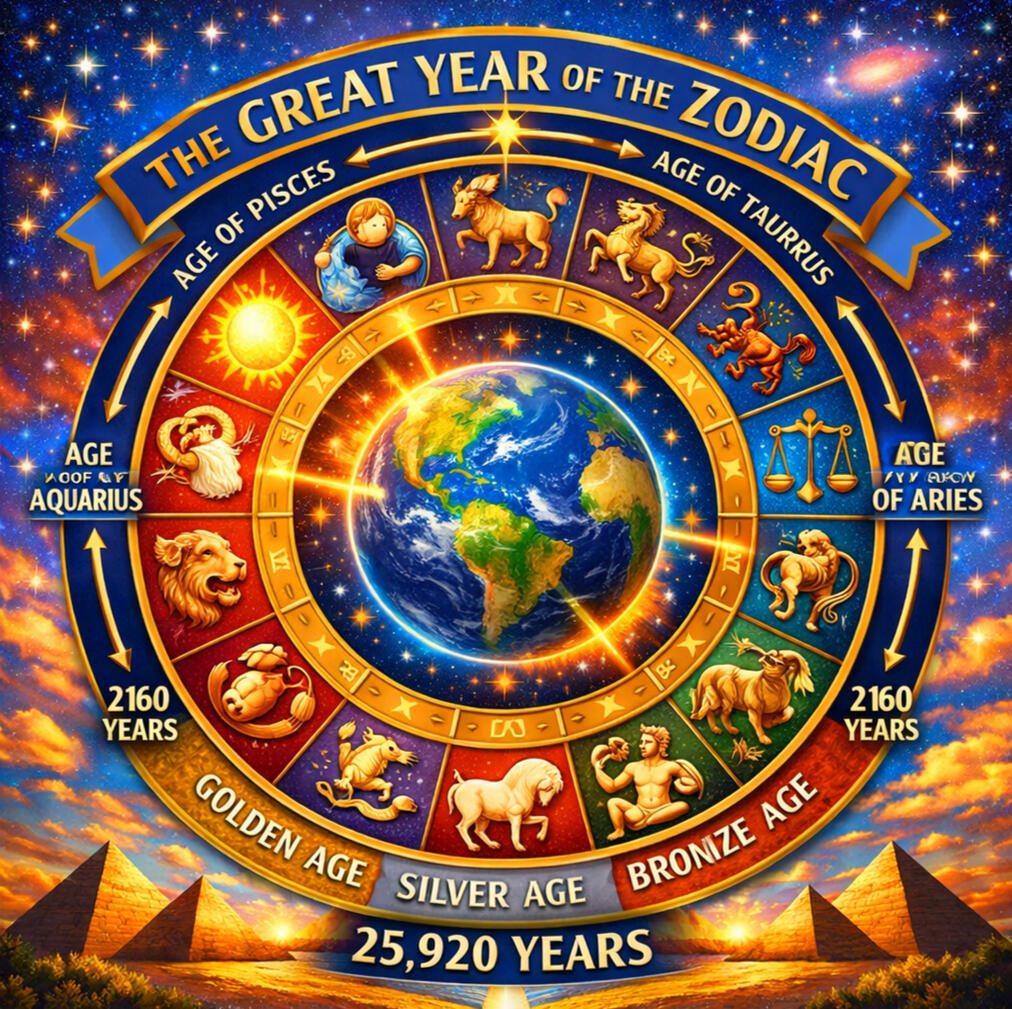
Each year, the Earth orbits the Sun, which appears each month against one of the 12 Zodiac constellations. It is now the season of a New Year. Every 72 years, the Sun appears to precede in its position against those constellations by 1°, called the Procession of the Equinox: the slow retrograde, or westward, motion of equinoctial points along the ecliptic resulting in earlier occurrence of equinoxes in each successive sidereal year.The complete cycle of precession takes about 26,000 years; this cycle is called a Great Year. Great Years can be divided into Great Months, or Ages, each lasting 2160 years.
Here we present the Great Years and Great Months as noted in Enzmann’s Chronology. The Chronology Archive is the result of Doc E’s efforts to combine all known timelines.The Great Zodiac Months of the current Great Year
Pisces - c. 26,920 to 23,760 BC
Aquarius - c. 23,760 to 21,600 BC
Capricorn - c. 21,600 to 19,440 BC
Sagittarius - c. 19,446 to 17,280 BC
Scorpius - c. 17,280 to 15,120 BC
Libra - c. 15,120 to 12,920 BC
Virgo - c. 12,860 to 10,960 BC
Leo - c. 10,800 to 8640 BC
Cancer - c. 8640 to 6480 BC
Gemini - c. 6480 to 4320 BC
Taurus - c. 4320 to 2160 BC
Aries - c. 2160 BC to BC/AD
Pisces - c. 0 BC/AD to 2160 AD
Aquarius - c. 2160 to 4320 AD, etc.The Zenith Neanderthal Great Year
106,616 BC
Neanderthals exterminated Homo Proto-Sapiens and Homo Sapiens in Europe, Middle East, North Africa, and Central AsiaToba Volcanic Great Year
80,690 BC
The Toba volcanic eruption is recorded to have severely affected the global climate for tens of thousands of years.65,000 BC
Evidence of an early competition between Sapiens and Neanderthal in Europe. Sapiens tools near Vienna, Austria, suggest the presence of a Homo Sapiens colony that was exterminated by Homo Neanderthalensis.
Trapunto in the Ice Age
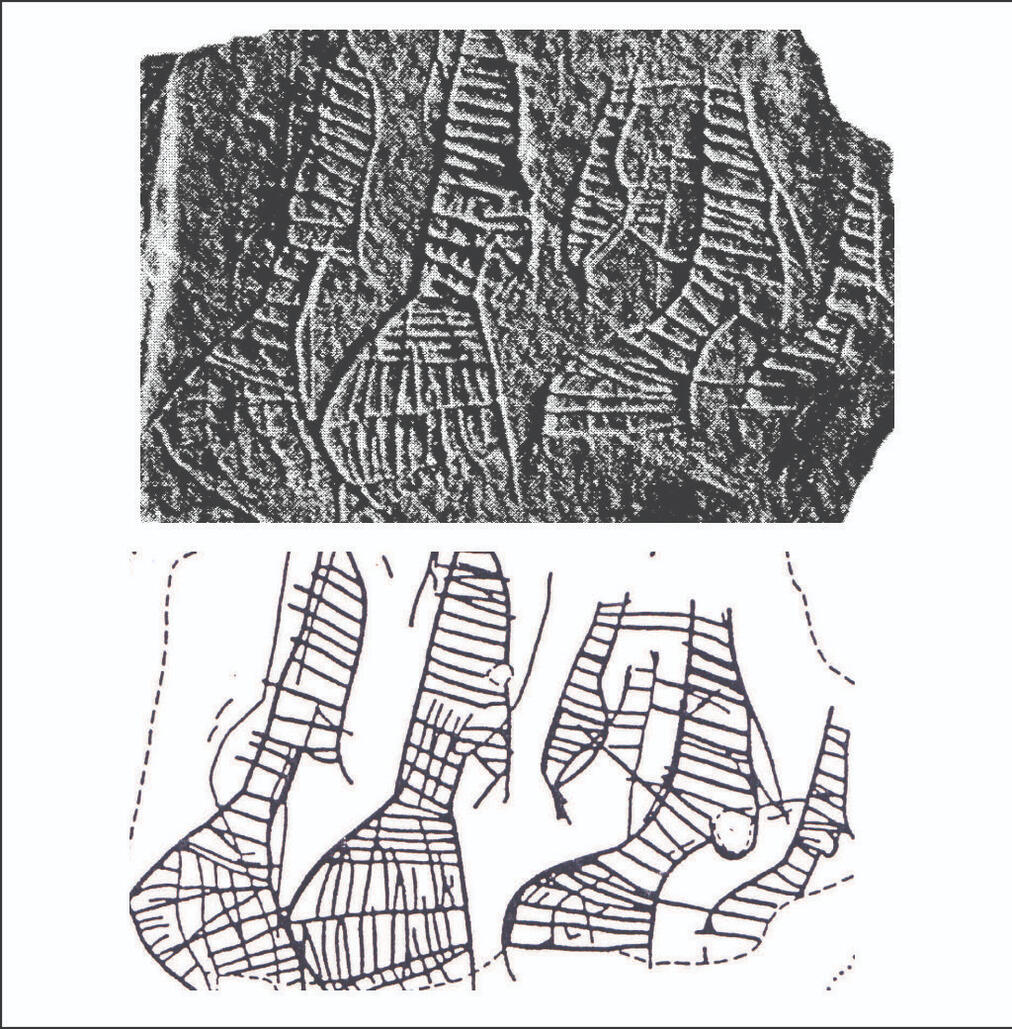
Pre-Indo-European homo sapiens survived the Ice Ages. How? Thousands of records of their ventures have been found throughout Europe painted, etched, and carved on stone, bone, and ivory. To the un-initiated these records look like scratchings or primitive art, but they are stories – and we can now read them.Family clans fought glacial winds in deep sub-zero temperatures in insulated homes with glowing fires for heat, light, and cooking. Burning cold air kept their houses warm and eliminated monoxide. Channels below the fire under the floor kept cold air flowing. Their infants were ideally conceived in spring, born in winter, and toddling by summer. Protecting and caring for their children at home secured survival. Oil lamps lit their homes at night while they spun and wove, teaching their children with stories, and they recorded their stories in stone.The salt gathered, the tool stones dug from ideal outcrops, the mammoths hunted, and the foods preserved were traded as markets developed. Specialties such as weaving, garment making, and needle making added importance to the markets. Some tribes traveled great distances to attend the annual (market) rendezvous.Gönnersdorf platte 156 is an inscribed stone record from the 12,500 BCE Pre-Indo European Bölling era (see photograph). This is one of hundreds found in the vicinity of buildings from the Magdalenian V Habergeon culture on a low Rhine terrace. This stone tells of a late winter excursion to trade with another hunting clan and to collect tool-making stones. Food-for-textile trading requires months of work and planning; platte 156 is an example of their records. Geographic symbols on this inscription tell where the excursion took place, calendrics tell when.The geographics and calendrics of Trapunto tell us late winter excursions required warm clothing; the clothing depicted is quilted (sewn) with down. There are four cardinal images depicting a family. A baby girl is carried by her mother. Men are also present in this record, indicated by ghosted lines. Men, women, the baby, and a little sister are venturing out to trade their textiles as a family business.
Introduction to the section on Environments
Robert Duncan-Enzmann
Annals of the New York Academy of Sciences, vol. 140, ART. 1.
Planetology and Space Mission Planning, 1966“What is space?” “What are we going to look at in space? Are there any regularities or patterns associated with the things of space? The content and arrangement of the papers in this section hive a generalized answer to these questions. It may seem surprising, but most of the papers are devoted to geospheres of the Earth. This has been done deliberately to indicate that the first object in space studied by mankind was the Earth. The Earth was first of all studied from its surface; and more recently from space, therewith creating new and useful geophysical systems.The regal importance of the Sun as the massive and energetic center of the Solar System is acknowledged by the paper entitled The Evolution of the Sun. The corona of the Sun consists of Electrofluxes of primary particles and ionized elements; it probably extends beyond Pluto. The satellites of the Sun form four regular groups: Terrestrial-Type planets such as Mercury, Venus, Earth and its Moon, And Mars. Asteroids mainly concentrated bands between the orbits of Mars and Jupiter; Jupiter-Type Gas Giant planets including Jupiter, Saturn, Uranus, Neptune and probably Pluto, and Comets known to be concentrated near Jupiter’s orbit (Jupiter’s family), and also know n as very long-period bodies that recede great distances from the Sun.The zoned substance of the Sun, the planets, asteroids, and comets are molded by the action of fields (mostly gravitational) and balances of exogenetic, endogenetic, and stored energies. Action of these fields, internal, external, and stored energies upon the geospheres of these bodies is considered in the papers: Energy, Time, and Morphology, and Endospheres and Inter-zonal Coupling. All of these bodies can be divided into one or more zones plasmas, gas, liquid, solid, or stress-fluid.* A planetary sphere composed of matter in one state is called a geosphere. The best explored, described, and mathematically-modeled geospheres are those of the Earth. These can serve as parametric models for all similar geospheres of other bodies; so the bulk of the Environments Session of the Conference was devoted to geospheres of a highly accessible and interesting planet of the Solar System, Mother Earth.*A stress fluid is a somewhat unscientific but useful term thatindicates the highly compressed matter of planetary interiors below the Mohorovicic Surface as being other than solid.
When Stone Spoke
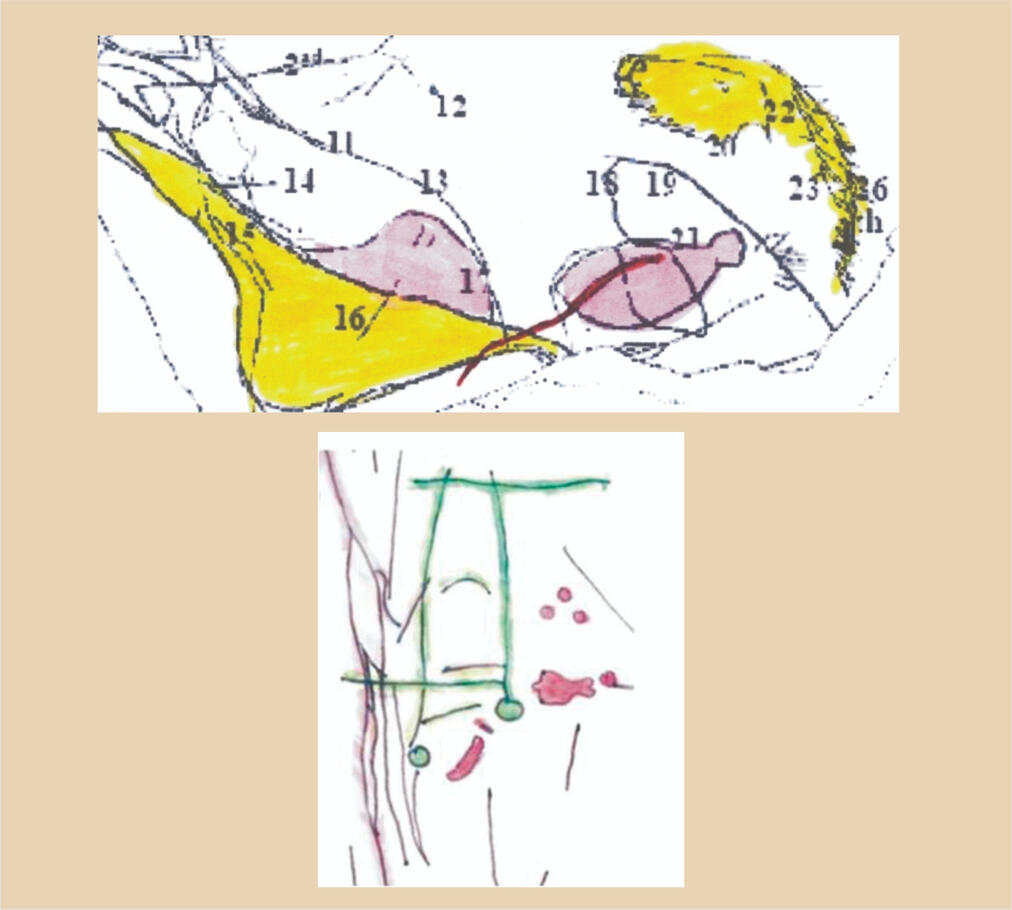
Our prehistoric ancestors had abilities and knowledge that generally go unrecognized. They documented their knowledge with symbols, which were combined with oral tradition and passed on from old to young and carry stories of social structures, medicines, home life, families, trade, struggles, and victories. These ancient records are engraved on the great continental megalithic village utilities as well as on small stones, ivory, and bones. Some of our oldest Faerie tales and mythologies also carry traces of our ice age ancestors.The late Dr. Duncan-Enzmann translated thousands of images from Gönnersdorf, Germany from 14,500 years ago during the iron cold Paleolithic Era. Images inscribed depict child care, housing, clothing, and calendrics. The picture-story in image A is about the birth of Lorelei, a Rhine maiden. Lorelei’s birth was certainly written (scratched in stone) by a lady of a small hunting family or clan. Numbers 16 & 1 indicate the pregnant mom, 21 is the baby born, connected by umbilical cord (in red), and 22 shows horses that bless baby with hair for warmth and bones for fat: the Horse Spirit blesses baby’s spirit. Lorelei is the beginning of the sun-child, and later sun-goddess mythology.The right clothing was essential for survival during an ice age; spinning and weaving have roots in Paleolithic family clans. Image B is an inscription showing a woman at a weighted-warp upright loom, with her oil lamp on the floor. This symbol is used in thousands of inscriptions discovered across Europe.Paleolithic mothers taught their daughters the art of spinning; little girls spun, mothers wove and dyed, and grannies tailored. While the women worked they told stories to pass on knowledge to their children (thus “spinning a yarn”). These generational practices led to the mythology of Maiden, Mother, and Crone as Norns working the threads of life in time.Artifacts, scraps surviving from our past, represent a great treasure. They provide valuable information and a tangible link to our ancestors. Some of the most intriguing and mysterious symbols of today have roots in prehistory; decoding them is possible in part because we have Duncan-Enzmann’s translations of this ice age language.
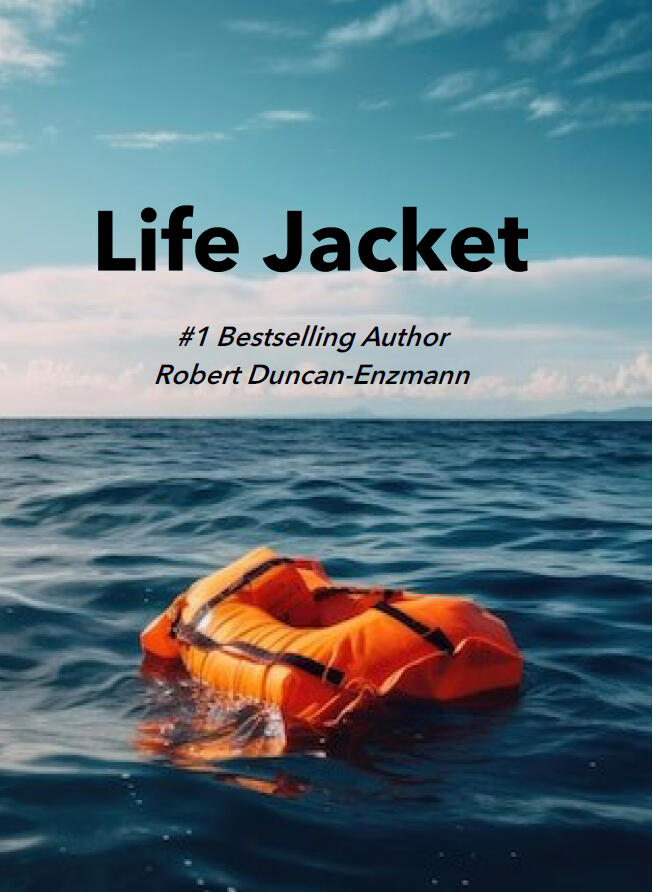
We are assigned to a modern American cruiser just off the ways (‘way’ is the slot a new ship slides down from the shipyard into the world ocean). It is sleek, well-manned, and excellently armed; a greyhound of the sea. We feel sort of invincible, sailing toward where we will be stationed in the south west Pacific.But!This is war. I have been sleeping far aft, port side. The first torpedo wakes me with a thump and heavy bump. It hit the starboard side bow. I’m on my feet when the second torpedo takes us starboard side betwixt bow and mid-ship. A terrible jerk takes me off my feet. Then our ship shudders, shudders, and lists staboard.How strange are the things one does in an ultimate emergency. We are going down, and it will be fast. I have to get out and quickly, but I take a moment, much less than a minute, to drink lots of water. Then I go up on deck and find with sheer luck a really modern life jacket and strap it on.God! A third torpedo takes us amid-ship, just moments after one of our two destroyed escorts it hit explodes. The mid-ship torpedo must have hit a magazine. Lady luck again, my knees are bent just right so that I am tossed up and over the side.I am well abow (in front of) my ship which is now listing some 200 and plunging sternward. Many seamen, though not a majority in life jackets, swim desperately. The ones in life jackets do most of the screaming as most of the ones near the ship are sucked down and die.Even I, well abow, am sucked toward the death pool, but the plunge is over just before I arrive, and is now just a shallow whirlpool.The sharks arrive. The ship is gone. Regular waves of the southern trade winds are running, I recon, about three feet high. Sharks some way off get a couple of sailors. I wish the submarine that got us would take some prisoners, it doesn’t surface at all. A guy swims past me, says lots of us are getting together to make noise and keep the sharks away. You should come to safety. I don’t believe him. I’m right.I float like a buoy. Ha, ha! Too much ass. Such awful screams and curses, and prayers to be saved. I even see the bloody mess as the sharks feast. They guys, some of em, fight with knives and marlin spikes, but its useless. I hang, glad I am upwind and updrift from them. A shark comes near me so I release packets of dye. The shark dislikes the smell and veers off to the big feast.Waves, trains go one way, wind currents another way, a current just below the surface goes in a third direction. Before the sharks go away, some of them rip each other apart. I’m guessing its sharks the seamen stabbed and cut with their knives. Pieces of life jackets float by. I get many packets of dye and keep them but find only one little bottle of water.If I make it I’m going to invent a really good life jacket. It will have a helmet you can pull up over your head, so as not to fall asleep, have your face fall forward and after a few times, drown.Night falls, then after a long starry night, day break and dawn. I shit diarrhea that costs water. Slowly I wash myself clean so as not to get sores. And then there’s another sailor in a really good jacket like mine. He says only a few things. “Hi, Lucky day, big eel I’ll catch and knife him. Damn! It bit me. I tingle all over, dizzy….”I have read about them, but have never seen one before. They are sea snakes, poisonous as cobras that went to live in the warm tropical oceans. The guy trembles, shivers, can’t talk and as I hold on to him, is soon dead. The snake he thought was an eel gone away. I search his pockets and jacket, finding a little bottle of water often put in life jacket pockets, water and a wallet. It is all right to do this, and I do it right. I take his life jacket, leave his crucifix. God will like my saying a prayer for him best as I can by adding to Now I lay me down to sleep. God will know I did my best.I used to think that people drifting to the bottom of the sea were buried in mud and become fossils. That is nice to think, but it doesn’t happen. Things down there the size (I think) of germs eat everything, even bones. But his clothes and crucifix will remain.After I get his dye packets, and the water, with a huge effort I tie the extra life jacket behind my head. It is a big help holding my head up. My fingers are wrinkled. My sisters, doing laundry, used to call that witches fingers, saying that the soap draws out water. It’s not that way. The water is going into my skin, so that is good. If I drink salt water I will soon die.Then on the evening of the second day about sunset time a great tree trunk with branches and knobs sticking out drifts near me. Its real white, no bark, small barnacles so it’s drifted a long time. I really test it, work hard testing it to see if it will roll. It won’t roll, and pull me under. My good luck, one side and its few branches insists on being on the side up and out of the water.I thank God. I can rest my head on a V in the white branches and really sleep. Then rested I wiggle up to where amidst the branches can be mostly out of the water, but always cool, I will die if I sweat. I caught a minnow then, ate it with a bit of candy, and drank some of the precious water. Thank goodness I have a hat. For a time I am feeling better.It’s delicious, lucid dreaming. I do lots of that. I see many beautiful things. I do lots of thinking about thinking. I worked it all out. No one has done that before, but I have worked it out, and often stop to have a lucid dream, then work out more and more about thinking about thinking. There is music thinking – remembering music. Things said come back over and over between lucid dreams, like hurry up or we will be late. Worries come, but I keep from doing that.Dressing up in military dress jumper, eating and drinking. Lots of that. Lots more, but I am losing – have lost track – of time, so I drink the last of the water, have the last wax paper wrapped piece of candy.I have drifted onto a beach some sailors say, caught in the branches still alive. Give him some water. I sip, again and again, water the sailors give me. That’s good, but I want to go back to dreaming, so I do. A truck comes and I’m in a hospital, so I fall out of the beautiful dream into real sleep. I woke up to hear a Navy Nurse saying to me, “Hi. Glad you have come back.” In a few days I am talking again, but only remember a little about the different ways of thinking I worked out so well when drifting. And the lucid dreaming that was so comfortingly beautiful as I drifted – I can’t do any more. I guess really sleeping stops it.Then I have one more thought. Being picked up by the Japanese would have been death, either real soon, dumped off the sub with a weight tied to my feet or months later as a slave worker.
Ancient Astronimcal Advances
For your reference: Timeline developed by R D Enzmann listing the progress made in astronomical observations and methods in prehistory.Important dates, sites, and astronomical discoveries in prehistory.BC Site Discovery
450,000 Bilzingsleben shadows and sundials
77,000 Blombos, S. Africa solar V
38,000 Vogelherd solar & lunar calendars
29,000 Chauvet tetra fauna calendrics
18,000 Altamira overlapped solar V
14,500 Lascaux precession recognized
12,500 Gönnersdorf solar azimuth
11,000 Göbekli Tepi siting holes and slots
8500 Early Stonehenge observatory
7500 Goseck, Carnac find level with water, find vertical with plumb
6500 Europe Venus clock, 7 planets, Named days of the week
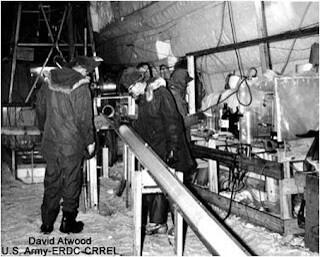
Shown: Camp Century, Greenland
Dates (BC) according to the Camp Century Ice Core45,000 Hengelo Denecamp
29,000 Aurignacian
21,000 Solutrean
14,500 Lascaux
12,500 Bølling
9000 Allerød
8000 Pre Boreal
6000 Boreal
5900 – 3750 Atlantic Grand Climate Optimum
Text
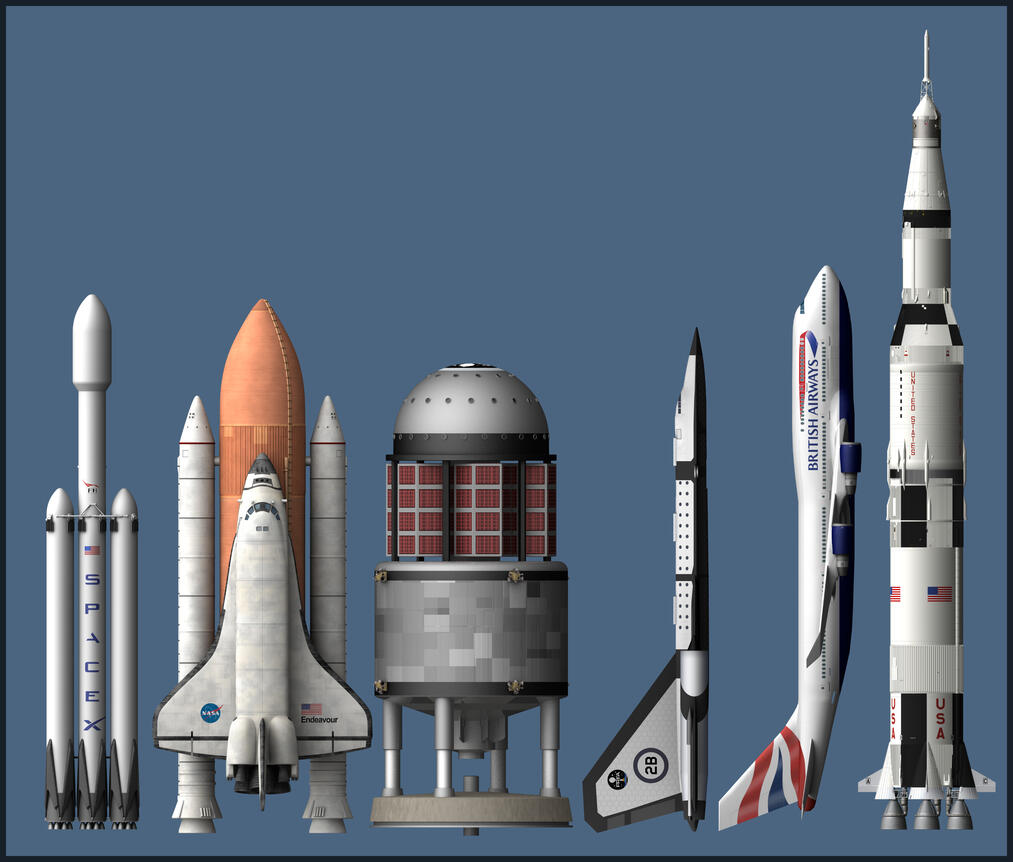
Engines for propulsion of ANP-Aerospace planes in atmospheres and space are a critical component when developing starships.Imagine that bringing an airliner across a runway, launching off its end fifty feet into the air, costs between two and five tons of fuel. Consider the ANP Engine. It weighs less than two tons. Two – even one – such engines can bring a Boeing 747 from the runway into the air and then keep it aloft for three years.Starships will need auxiliary vehicles. To imagine that they will carry gasoline, jet fuel, or such to power aerospace planes is patent absurdity.ANP-Aerospace planes will have to operate in space as well as in atmospheres. To do this with reaction mass is almost unthinkable. They will have to be equipped with mini lance drives. These drives will run the length of the ships. They will be driven by small reactors about the size of baseballs in the tail of the craft.Enzmann's ANP is shown here in comparison to other well-known vehicles. It says 2B on the fin.